The Rhyme Game
- 4.4
- Rating
- 50.00K
- Installs
- Free
- Price
 Analysis by App-foxy
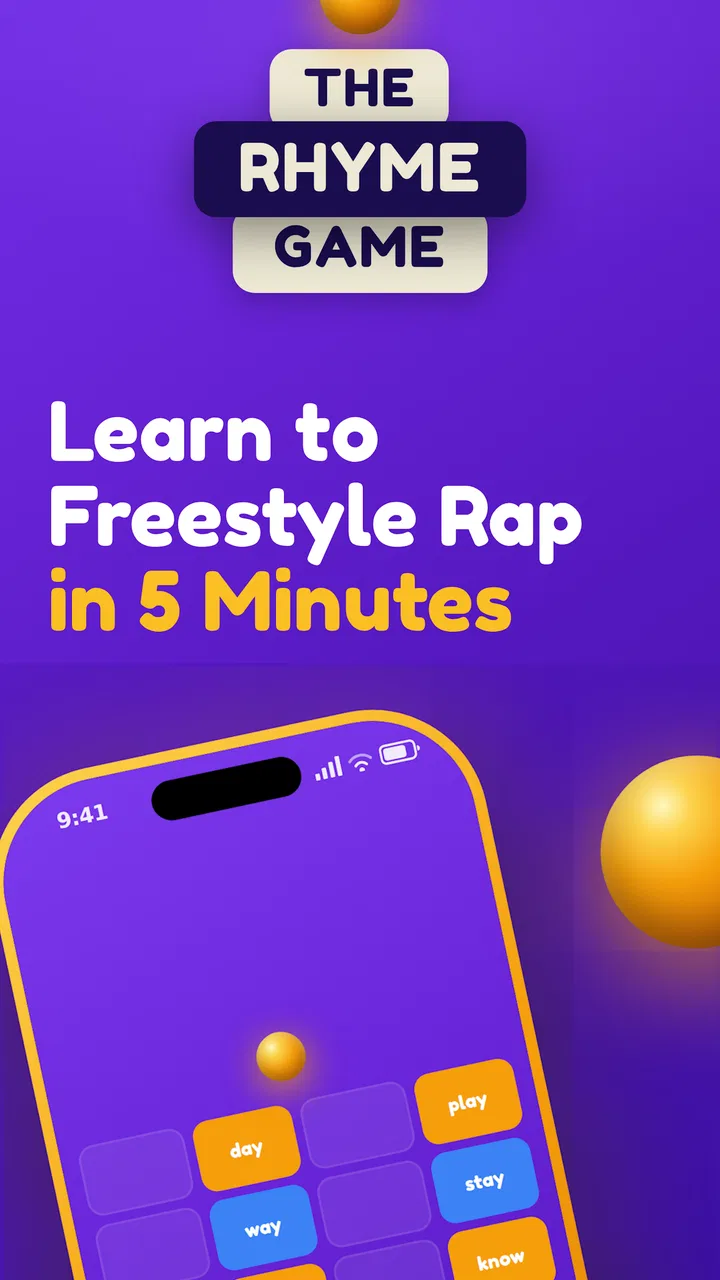
I approached The Rhyme Game as a small, focused music game rather than a full songwriting studio, and that distinction matters. Its purpose is to help me practise freestyle rap in a playful way, with short sessions that feel closer to a creative exercise than a formal lesson. The concept is simple: I am given a reason to think quickly, connect words, and keep a rhyme moving instead of staring at an empty page.
That makes it appealing when I want to loosen up before writing lyrics, practise reacting without overthinking, or turn a spare moment into something creative. It is free to start, although optional in-app purchases range from 99 cents to $29.99 per item. The game is made by Creative Rhythm, carries a Teen content rating, and runs on Android 7.0 or later. I would not mistake it for a complete rap course, but I do think it has a clear role for beginners and casual writers who need a nudge to start.
How the game feels in its current form
The strongest part of the experience is its narrow focus. Instead of trying to be a general music-learning platform, it centres the moment when a rapper has to find a word, make a connection, and continue the thought. That focus gives each session a useful mental rhythm. I can open it with no instrument, microphone setup, or music theory knowledge and immediately treat it as a warm-up.
You May Also Like

 AccuWeather: Weather Radar
AccuWeather Review: A Quick, Clear Forecast for Everyday Decisions
For everyday plans, the best forecast is the one you can understand quickly. AccuWeather makes rain timing, radar, and local conditions easy to act on, with a few trade-offs.

 Hill Climb Racing
Why Hill Climb Racing Still Turns Crashes Into One More Run
A tiny car, a bumpy hill and one more upgrade: Hill Climb Racing keeps resurfacing because its simple chaos makes every near-miss feel personal.

 AliExpress - Shopping App
AliExpress Makes Global Shopping Feel Personal, but Shoppers Bear the Risk
AliExpress turns a global marketplace into a pocket-sized discovery engine. Its reach is useful, its shopping loop compelling, and its trade-offs easy to miss.

 Lords Mobile: Kingdom Wars
Lords Mobile Is a Kingdom-Building Routine, Not a Quick Match
A case-by-case verdict on the building, battles, device demands, and social commitments that make Lords Mobile rewarding for some players and exhausting for others.

 PDF Scanner app - TapScanner
TapScanner Makes Paperwork Easier to Capture, Check, and Share
TapScanner makes scanning with a phone feel less like a rescue operation and more like a dependable step in getting work done. Its capture tools are useful, though not flawless.

 Block Blast!
 Shows How Much a Puzzle Game Can Leave Out
A quiet grid game shows why puzzle players increasingly value instant clarity, repeatable skill and low-pressure play—and where the genre still needs to catch up.
More From Our News Desk
View All News


In practice, I found the game most useful when I stopped treating every answer as something that had to be impressive. Freestyle practice becomes frustrating if I judge every line like a finished song. The better approach is to use the prompts as repetitions: respond quickly, accept a few awkward rhymes, and notice which sounds or ideas come naturally. That mindset turns the app from a test into a low-pressure training tool.
The store summary describes it as a fast way to learn freestyle rap, while the short description presents it as a rhyme game. Those descriptions are brief, but they point to the right expectation. This is not an arrangement app, beat-making workstation, or vocal recording suite. Its value is in encouraging wordplay and speed. If I want to build a polished track from drums, melodies, takes, and effects, I need a different kind of app.
The current release is version 3.3.15, and the product has been available since February 13, 2024. I see that as a sign of an established, actively shaped product rather than a one-screen experiment, but I still judge it by what it does in a session: it gives me a reason to practise rhyming and keeps the activity approachable.
A useful starting point for beginners
New rappers often know they want to write but do not know how to begin. A blank notes page creates too many choices at once: topic, flow, rhyme pattern, tone, and length. A focused game can remove some of that pressure. I can concentrate on one response at a time instead of trying to invent an entire verse immediately.
That is especially useful for someone who feels embarrassed about practising aloud. A private game-like setting makes imperfect attempts feel less serious. I can try a simple rhyme, repeat the exercise, and gradually become more comfortable with quick associations. The app is therefore better suited to building a habit than to delivering a deep explanation of rap technique.
More experienced writers may also find a place for it, but probably as a warm-up rather than a main creative tool. Before recording, I might use a short session to wake up my vocabulary. Before a writing block, I could use it to break a predictable pattern of thinking. The benefit is not that it replaces deliberate lyric editing; it is that it can help me reach the point where ideas begin to move.
Where it fits in a normal day
A realistic use case is a short break between tasks. I might have ten minutes before leaving for an appointment, open the game, and use that time to practise quick rhymes instead of scrolling through unrelated content. I would not expect a complete song from that session. I would expect a few unexpected word connections that I could later carry into a notes app or notebook.
Another useful routine is to play before writing rather than after. The game can act as a mental stretch: I respond without editing, then switch to a more serious writing environment once my brain is active. This separation is important. The game encourages spontaneity, while a writing app is better for keeping lines, revising syllables, and arranging a verse. Using each tool for its proper job prevents disappointment.
I can also imagine using it with a friend as a friendly challenge, provided both people are comfortable improvising. The competitive element should remain light. Freestyle practice works best when mistakes are treated as part of the process, not as evidence that someone lacks talent.
What the recent version means for existing players
For someone already using the game, version 3.3.15 is the release to look for now. The version information gives existing players a clear reference point when checking whether they are running the current build. It is sensible to keep the installed version aligned with the current one, particularly for a game whose small interactions and prompts are central to its usefulness.
I would be careful, however, not to read a version number as proof of a particular new feature. Without a detailed change history, the responsible conclusion is simply that the present product has reached this release and should be evaluated on its current experience. Existing users should update through their normal app store process and then judge whether the app feels stable and comfortable in their own routine.
The release date also helps frame the product’s maturity. It is not a decades-old teaching method translated into an app, nor is it something I would describe as a long-established standard in music education. It belongs to the newer generation of compact creative tools that try to make practice feel more like play. That can be refreshing, but it also means I would keep my expectations practical and avoid treating it as a complete curriculum.
Three ways to get more from the rhyme practice
My first tip is to separate speed from quality. On the first pass, I would answer as quickly as possible, even if the rhyme is obvious. On a later pass, I would slow down and look for a more interesting connection. This two-stage approach uses the game for both reflexes and creativity without demanding that every response perform both jobs at once.
My second tip is to collect the useful leftovers. If a prompt produces a phrase or image that feels promising, I would write it down immediately after the session. The game is a generator of starting points, not necessarily the place where I should complete them. A rough line can become a hook, a verse theme, or simply a reminder to explore a different sound family later.
My third tip is to practise with a limitation. I might decide to keep the same subject for several responses, avoid the first obvious rhyme, or aim for multisyllabic sounds when I feel ready. The app provides the spark, but the constraint adds deliberate practice. This is a more valuable routine than repeatedly chasing a high score or trying to sound polished from the first attempt.
A fourth useful habit is to speak clearly rather than mumble through a response. Freestyle is not only about finding matching endings. It also involves timing, confidence, and making the words understandable. Even if the game is primarily a rhyme exercise, I can use my own voice and delivery as part of the practice. That turns a quick round into a small performance drill.
Where it falls short
The focused design is also its main limitation. If I want structured lessons about rhythm, breath control, song structure, internal rhyme, or recording technique, this game will not be enough on its own. A dedicated songwriting course may explain concepts more clearly, while a digital audio workstation will offer far more control over beats and vocal takes. The Rhyme Game is best viewed as one tool in a wider creative routine.
It may also disappoint users who expect a large social experience, a complete beat library, or a professional recording workflow. Those expectations belong to other categories. This app’s appeal depends on enjoying the act of responding to rhyme-focused challenges. If I do not like word games or feel uncomfortable improvising, the central mechanic may become repetitive rather than motivating.
The Teen rating is another reason for parents and younger users to consider suitability before playing. It indicates that the app is not positioned as a children’s learning game. I would also remember that the free entry point does not mean every possible item or option is included without cost. Optional purchases can reach $29.99 for an item, so I would review any purchase screen carefully and decide in advance whether I want to spend money.
That pricing range changes the way I recommend it. For a curious beginner, the free starting point makes it reasonable to try before committing. For someone looking for a guaranteed, comprehensive course, I would compare the cost of optional items with a structured alternative before paying. The right choice depends on whether I want playful repetition or a planned learning path.
How it compares with familiar alternatives
Compared with a notes app, The Rhyme Game gives me a prompt and a reason to respond now. A notes app is more flexible and better for preserving finished ideas, but it does not automatically create the same sense of exercise. I would use the game to generate momentum, then move the strongest material into notes for editing.
Compared with watching freestyle tutorials, the game is more active. Videos can explain technique and show strong examples, but they encourage me to observe. This app asks me to produce something. The trade-off is depth: tutorials may teach concepts that the game leaves for me to discover through repetition.
Compared with a beat-making app, it is much lighter and less technical. That is an advantage when I want to practise words without adjusting tempo, instruments, or effects. It is a disadvantage when the beat itself is what helps me find a flow. Producers and recording-focused artists will probably want both types of tool, while a complete beginner may prefer starting here before adding more complicated software.
Compared with a formal music-learning platform, it feels more casual and specific. A course can provide progression across several skills, whereas this game concentrates on the rhyme and freestyle side of rap. I would choose it for quick creative practice, not as my only route to becoming a stronger musician.
Who should try it, and who should skip it
I would recommend it to beginners who want a friendly entry into freestyle rap, writers who need a warm-up, and casual players who enjoy language-based challenges. It also suits people who prefer learning by doing. The low barrier is meaningful: I do not need to prepare a studio session before I can practise.
I would be more cautious about recommending it to someone seeking formal instruction, advanced vocal coaching, or professional production features. It is also not the right choice for a person who dislikes improvisation and would rather compose every line slowly. In that case, a writing tool or structured course would provide a better match.
The audience size suggests that it has already attracted a modest community, with over ten thousand installs and an average rating of 4.4 from around 155 ratings. Those figures make it look encouraging without making it a universal standard. I would treat the rating as a useful signal, then decide based on whether the game’s narrow purpose matches my own goals.
What I would watch as the product develops
The most important future question is whether Creative Rhythm continues to deepen the practice without losing the quick, approachable feel. I would like to see the game remain useful for first-time players while giving returning users reasons to refine their technique. More variety in the kinds of challenges, clearer progression, or better ways to turn a spontaneous response into a saved idea could all make repeated sessions more rewarding, but I would not assume those changes are already present.
I would also watch how the optional purchases affect the free experience. A free entry point is valuable when it lets me understand the core loop before spending anything. If paid items become necessary for meaningful practice, the balance would feel less attractive. For now, I would approach purchases as optional extras and make the decision only after I know I will use the game regularly.
Finally, I would watch whether the app keeps its identity. Its strength is not trying to replace every music app on my phone. It works because it gives freestyle practice a compact, game-like home. Expansion should support that purpose rather than bury it beneath unrelated tools.
My final view is positive but specific: The Rhyme Game is worth trying if I want a quick way to exercise rhyme instincts and start improvising. I would use it as a warm-up, a creativity reset, or a bridge between having no idea and writing a rough first line. I would not rely on it as a complete rap education or production setup. Its best value comes from turning hesitation into practice, and that is enough to make it a useful free addition for the right kind of music learner.
FAQs for The Rhyme Game
01What is The Rhyme Game and how does it work?
The Rhyme Game is an interactive word game designed to enhance your vocabulary and rhyming skills. Players are given prompts and must create words or phrases that rhyme with them. The game includes various levels of difficulty, so it’s suitable for both beginners and advanced players. It’s available on both Android and iOS platforms.
02Is The Rhyme Game suitable for all age groups?
Yes, The Rhyme Game is designed to be family-friendly and is suitable for all age groups. It features different levels of difficulty, making it accessible for children who are just learning to rhyme, as well as adults looking to challenge themselves. Parental controls can also be set to ensure age-appropriate content.
03Are there any in-app purchases in The Rhyme Game?
While The Rhyme Game can be enjoyed for free, there are optional in-app purchases. These purchases can unlock additional levels, special features, and ad-free gameplay. However, the core experience of the game is fully accessible without spending money, allowing players to enjoy it without any financial commitment.
04Does The Rhyme Game require an internet connection?
The Rhyme Game can be played offline, which makes it perfect for on-the-go entertainment. However, some features, such as leaderboards and multiplayer modes, require an internet connection to function. Offline play ensures that you can enjoy the game anytime, anywhere, without the need for Wi-Fi or mobile data.
05How does The Rhyme Game support language learning?
The Rhyme Game is an excellent tool for language learners as it helps improve vocabulary and pronunciation through rhyming challenges. The game supports multiple languages, allowing users to practice rhyming in the language of their choice. This feature makes it a fun and educational resource for learners of all levels.
Pros
- Engaging gameplay with creative word challenges.
- Colorful and intuitive user interface.
- Regular updates with new levels and features.
- Multiplayer mode for competitive fun.
- Offline access for play on the go.
Cons
- Limited hints can be frustrating for beginners.
- Some ads interrupt the game flow.
- Occasional bugs in multiplayer mode.
- Requires internet for leaderboards.
- In-app purchases can be costly.

The Rhyme Game
Gallery